
Air conditioning stops working in August. A heater gives out on the coldest morning of the year. When that happens, someone has to figure it out quickly and fix it properly. That someone is an HVAC technician.
If you’re researching how to become an HVAC technician in California, the path is practical and straightforward. You complete focused training. You earn the required certification. You gain field experience. Over time, you build real technical confidence.
This is hands-on work. You’re wiring components, testing systems, diagnosing faults, and solving real problems in real spaces. For many people, that’s exactly the appeal.
Let’s break down the steps.
Step 1: Meet the Basic Requirements
Before enrolling in training, you’ll need to meet a few general criteria.
Most HVAC programs require:
- A high school diploma or GED
- Minimum age requirement (usually 18)
- Ability to perform physical work such as lifting equipment and working in tight spaces
- Many HVAC employers also require a valid driver’s license, since technicians frequently travel between job sites in company vehicles
These are standard HVAC technician requirements in California. The job is active and technical, so physical readiness and attention to detail matter.
If you’ve been out of school for a while, that’s okay. Many students entering HVAC training aren’t coming directly from high school. The learning is structured but grounded in real-world application—not just theory.
If you’re unsure what documentation or qualifications are needed before enrolling, reviewing the school’s Admissions page can help clarify what to expect.
Step 2: Complete HVAC Training in California
Why Structured Training Matters
You can enter HVAC through apprenticeships, but many people choose trade school because it offers concentrated, hands-on instruction in a shorter timeframe.
Instead of piecing together knowledge over several years, you immerse yourself in it.
A strong HVAC training program should include:
- Electrical fundamentals
- Refrigeration systems
- Heating systems (gas, electric, heat pumps)
- Air conditioning systems
- System diagnostics and troubleshooting
- Installation and preventive maintenance
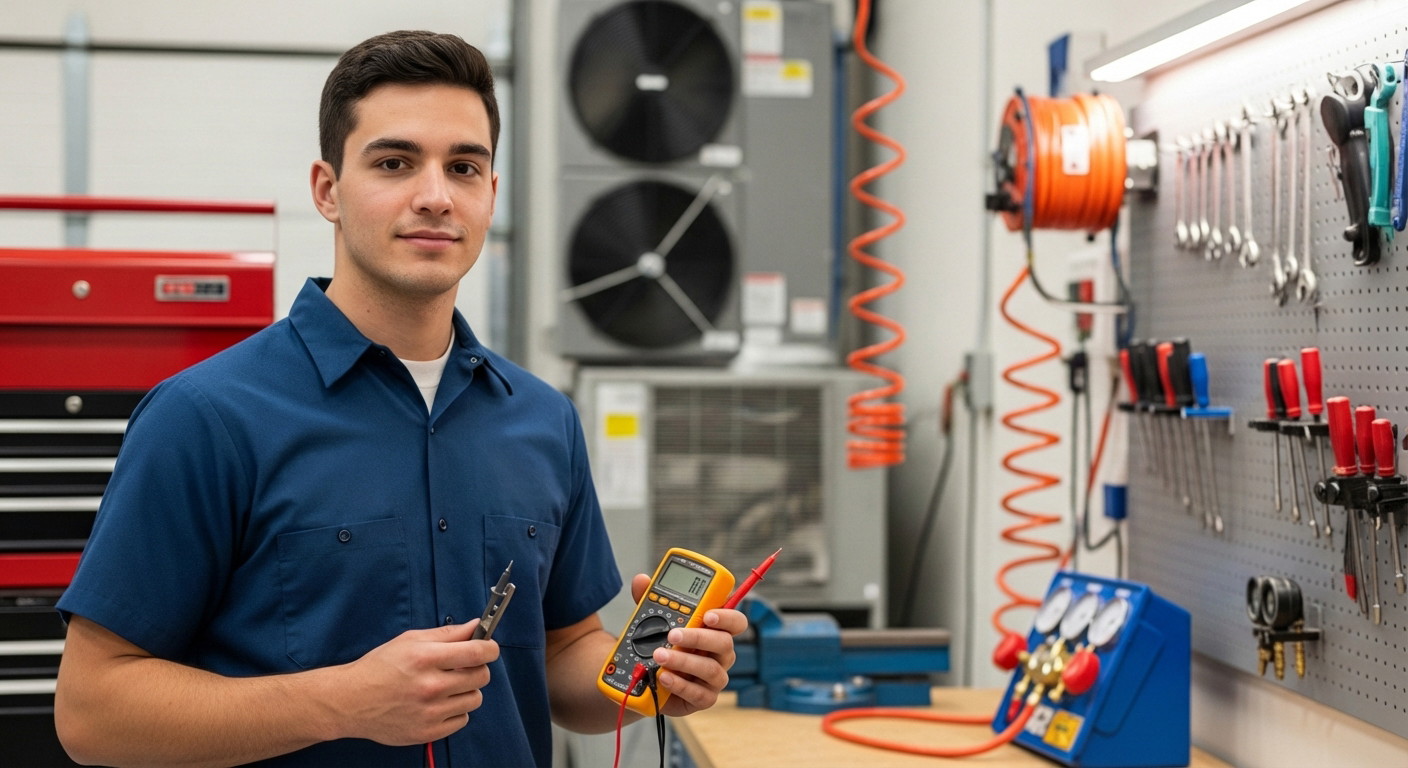
At Brownson, the HVAC Technician Program includes 1,040 hours of hands-on instruction completed over 10 months* of full-time training. Students work directly with wiring, compressors, motors, and gauges, building familiarity through repetition.
That repetition is key. HVAC work requires comfort with tools and systems. The more time you spend in the lab, the smoother the transition into the field.
When comparing HVAC training options in California, look closely at lab hours and equipment access—not just program length.
Step 3: Earn EPA Section 608 Certification
A Required Step for Most Technicians
If you plan to handle refrigerants (and most HVAC technicians do), you’ll need to earn EPA Section 608 certification. This is a federal requirement.
EPA 608 certification applies to technicians who maintain, service, repair, or dispose of equipment that could release refrigerants.[1] Without it, many standard HVAC tasks simply aren’t allowed.
There are four types:
- Type I – Small appliances
- Type II – High-pressure systems
- Type III – Low-pressure systems
- Universal – Covers all three
Most technicians pursue Universal certification because it provides the broadest scope of work.
In many training programs, exam preparation is integrated into coursework so students are prepared to take exams before graduation. That’s something worth confirming when researching schools.
Step 4: Gain Field Experience
Where Training Turns Into Skill
After completing training and certification, you move into entry-level roles such as:
- Installation assistant
- Maintenance technician
- Service technician trainee
This is where your technical understanding becomes practical judgment. You’ll work in homes, office buildings, schools, and commercial facilities. Systems vary. Conditions vary. No two job sites feel exactly the same.
According to CareerOneStop, HVAC employment in California is projected to grow by 11%, adding approximately 3,790 new positions annually.[2] Heating and cooling systems are part of everyday life across Southern California and the state as a whole, which helps explain the steady demand for skilled technicians.
Early experience builds speed, confidence, and communication skills — all just as important as technical ability.
Step 5: Understand California HVAC License Requirements
Technician vs. Contractor
There’s an important distinction here.
Working under a licensed contractor is different from operating independently as one.
In California, projects valued at $500 or more require a contractor’s license.[3]To qualify, technicians typically need verified work experience and must pass a state exam.
Not everyone pursues a contractor’s license right away. Some technicians build experience first. Others eventually move into business ownership.
Understanding California HVAC license requirements early helps you think long-term — even if independence isn’t your immediate goal.
Specializations in the HVAC Field
As you gain experience, you may discover certain systems interest you more than others.
Common specializations include:
- Residential service and installation
- Commercial HVAC systems
- Industrial refrigeration
- Building automation and Direct Digital Controls (DDC)
- Energy efficiency optimization
Commercial buildings rely heavily on computerized control systems. Exposure to automation during training can make that transition easier.
The HVAC Technician Program introduces students to these technologies as part of broader instruction, helping build familiarity with both mechanical and digital systems.
How Long Does It Take?
Comparing Common Pathways
This is one of the most common questions people ask when researching how to become an HVAC technician in California.
Here’s a general breakdown:
- Trade school program: Often under one year
- Associate degree: Associate degree programs are often designed as two-year programs, but in many Southern California community colleges they may take closer to 2.5–3 years to complete due to course availability and scheduling
- Apprenticeship-only path: Several years, depending on the structure
At Brownson, the HVAC Technician Program is designed to be completed in 10 months* when attended full-time. That concentrated format appeals to those who want focused, immersive training.
Your timeline depends on your schedule and how quickly you move into the field — but structured training provides clarity from day one.
Planning for Tuition and Support
Before enrolling, many prospective students also explore funding options. Reviewing available Financial Aid information can help you understand what documentation and timelines may be involved.
Even if you’re still in the research phase, knowing how funding works can make planning easier.
Is HVAC the Right Fit?
HVAC work is technical, physical, and problem-driven. It requires troubleshooting, attention to detail, and comfort working with tools.
If you prefer solving tangible problems and seeing immediate results from your effort, this field offers a structured path forward.
Learning how to become an HVAC technician in California comes down to a few steady steps: complete your training, earn certification, gain experience, and understand licensing.
From there, you build skill and confidence one system at a time.
Ready to Take the Next Step?
If you’re exploring HVAC training options in Southern California, taking a closer look at the HVAC Technician Program can help you see how hands-on lab work, certification preparation, and focused training come together in a practical 10-month* format.
Footnotes
*Program length when completed in normal time.
- https://www.epa.gov/section608/section-608-technician-certification-requirements
- https://www.careeronestop.org/Toolkit/Careers/Occupations/occupation-profile.aspx?keyword=Heating,%20Air%20Conditioning,%20and%20Refrigeration%20Mechanics%20and%20Installers&location=California&onetcode=49902100
- https://www.housecallpro.com/hvac/licensing/california/