
So you’ve decided HVAC might be the move. Good choice. The next question is the one that shapes your timeline: How will you train?
In California, most people considering this career face the same decision: HVAC trade school vs. apprenticeship. Both routes can lead to a stable, long-term career. The difference isn’t whether you can succeed. It’s how you build your skills at the beginning.
In a field where precision matters and certification is required, that foundation counts.Let’s look at what each path really involves.
Understanding the Two Main HVAC Pathways
Before comparing them side by side, it helps to understand how these training models feel in practice.
What Is HVAC Trade School?
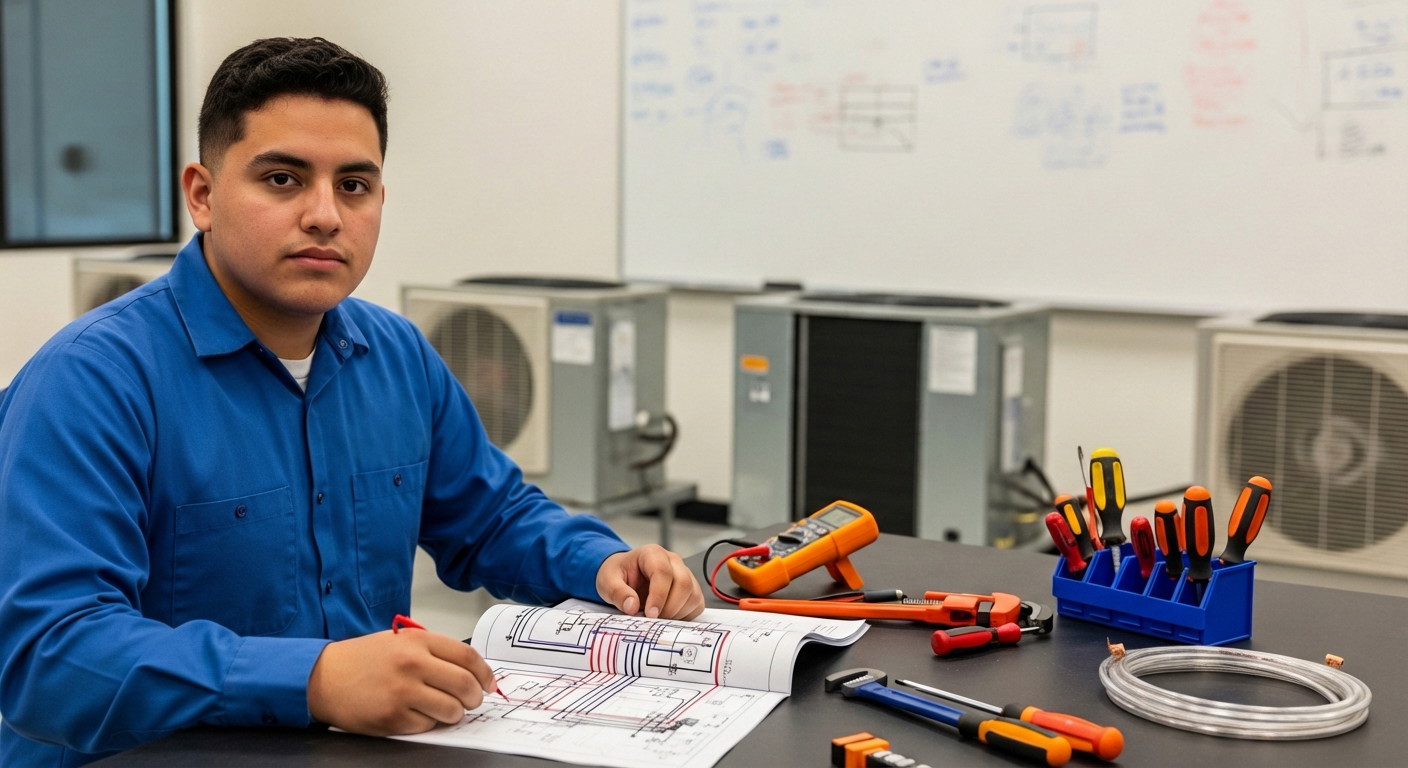
Trade school is structured. You follow a defined curriculum. You spend real time in a lab. You practice troubleshooting before a customer is standing next to you, waiting for answers.
At Brownson, the HVAC Technician Program can be completed in 10 Months* Full-Time or 22 Months* Part-Time. Students complete 1,040 hours of hands-on instruction in a 12,000 sq. ft. shop, working on a range of residential and commercial systems.
That includes:
- Installation and system repair
- Electrical diagnostics
- Refrigerant handling and EPA compliance
- Direct Digital Controls (DDC)
- Building performance testing
One of the biggest differences here is predictability. You know your schedule. You know when you’ll finish. You know what skills you’re expected to leave with.
If you want a clearer sense of how that lab environment builds confidence, the real-world skills you’ll master at HVAC trade school gives a practical breakdown.
What Is an HVAC Apprenticeship?
An apprenticeship places you directly on job sites under a licensed contractor. You’re working. You’re earning. You’re learning in real time.
Apprenticeships in California often range from one to five years, depending on the program and employer. [1] Advancement happens gradually as you accumulate experience hours.
What you work on depends heavily on your employer’s projects. You might gain broad exposure early on. Or you might spend a long stretch focused mostly on residential systems. It varies.
For many people, earning income while learning is a major draw. The tradeoff is that the pace and scope of training are less controlled. Apprentices also typically start at lower wages than graduates who enter the field with completed training and certifications.
HVAC Trade School vs Apprenticeship: Where the Differences Show
When people compare HVAC trade school vs apprenticeship, the key distinctions tend to fall into three areas: timeline, structure, and early exposure.
Timeline
Trade school operates on a set schedule. At Brownson, students can complete training in as little as 10 months full-time.*
Apprenticeships take longer. While you are paid during training, progression typically stretches over several years. [1]
If you’re eager to enter the workforce with formal training completed, structure can feel more direct.
Structure and Skill Development
Trade school gives you repetition. You troubleshoot. Then you troubleshoot again. You work on systems in a controlled setting before stepping into someone’s home or a commercial facility.
Apprenticeships drop you into the real world immediately. That can quickly build resilience and practical awareness, but the experience depends on the range of jobs your employer handles.
Some learners want structured repetition before high-pressure environments. Others prefer immersion from day one. Neither preference is wrong — it’s about fit.
Certification Preparation
Handling refrigerants legally requires EPA Section 608 certification. Many trade school programs integrate certification preparation directly into the curriculum.
Apprentices still must obtain required certifications, but timing can depend on employer scheduling and support.
If you’re trying to understand how certification fits into your overall timeline, how long does it take for HVAC certification? A complete guide provides a more detailed look.
Technology Exposure
In structured programs, exposure to systems like Direct Digital Controls and Building Automation is built into training.
In apprenticeship settings, exposure depends on the projects your employer secures. Some apprentices see advanced systems early. Others may not encounter them until later.
If you value guaranteed exposure to a range of technologies before entering the field independently, that’s something to weigh.
The California Factor
California’s climate alone ensures steady demand for HVAC services. With ongoing construction and energy-efficiency initiatives, the need for trained technicians remains consistent.
Industry stability is one reason people explore this path in the first place. For a broader look at the long-term outlook,10 reasons HVAC technician careers offer job security explores what keeps this field resilient.
Regardless of your starting path, contractor licensing in California requires documented experience. To sit for the contractor exam, you must demonstrate at least four years of qualifying work experience under a licensed contractor. [1]
Both apprentices and trade school graduates move toward that goal over time.
Who Might Lean Toward Trade School?
Trade school often makes sense if you:
- Prefer a structured learning environment
- Want a defined completion timeline
- Value repeated hands-on troubleshooting before entering job sites
- Want certification preparation built into your training
Programs like the HVAC Technician Program concentrate technical instruction into a focused 10- or 22-month format.* That concentration can help some students feel more prepared when stepping into entry-level roles.
There’s something to be said for practicing in a lab before diagnosing live systems in front of customers.
Who Might Lean Toward Apprenticeship?
An apprenticeship may be the right fit if you:
- Prefer earning income immediately
- Learn best by doing, even if it means slower progression
- Are you comfortable with a longer, staged path
It can be a strong route for those who thrive in real-world environments and are patient with incremental growth.
If you’re still figuring out how to enter the field at all, how to get into HVAC with no experience: beginners guide to starting your career breaks down early steps.
So, Which Path Is Right?
Choosing between an HVAC trade school vs apprenticeship isn’t about declaring one superior. It’s about understanding how you want to start.
Trade school offers structure, concentrated training, and defined certification preparation. Apprenticeships offer paid, gradual immersion into job site environments.
In competitive markets like Southern California, entering the workforce with comprehensive, lab-tested experience can make that first transition smoother for some students.
If you’re evaluating structured training options, reviewing the HVAC Technician Program details can give you a clearer picture of how a defined program compares to apprenticeship timelines and expectations.
Footnotes
*Program length when completed in normal time.